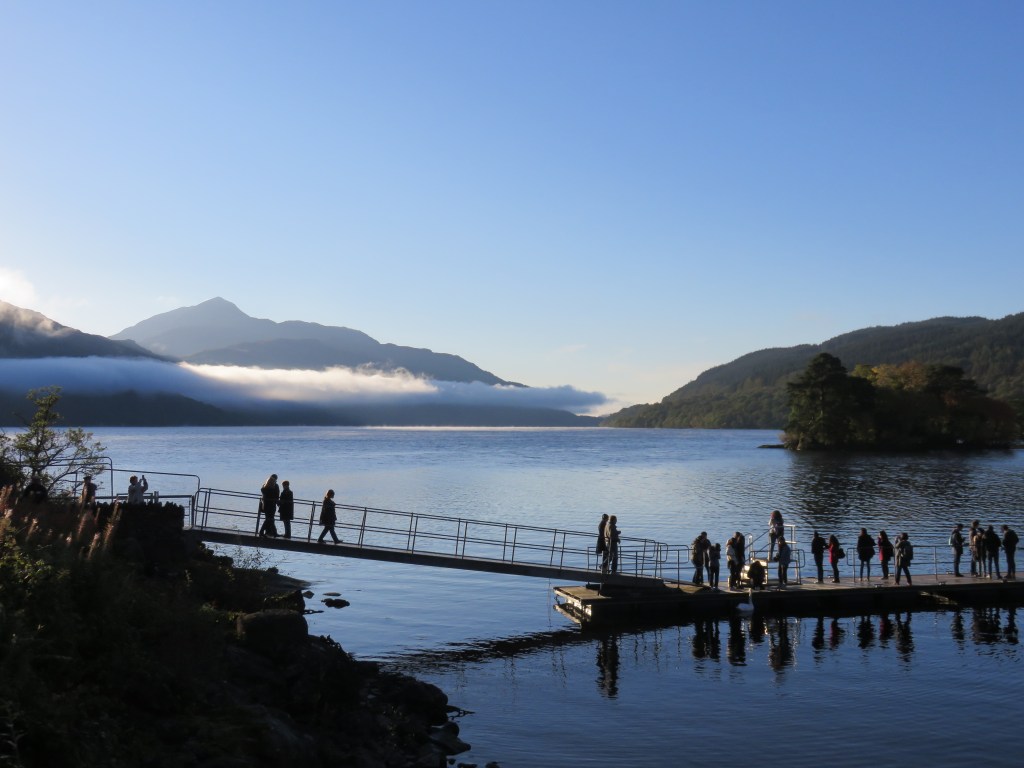
Treebeard: “We Ents cannot hold back this storm. We must weather such things as we have always done.”
Merry: “How can that be your decision?”
Treebeard: “This is not our war.”
Merry: “But you’re part of this world, aren’t you? You must help!…. Please.”
— The Lord of the Rings: The Two Towers
It starts, as it always does, out on the porch — and, no matter how far it travels, beyond the seven seas and all manner of foreign realms both benevolent and bent on destruction, maybe that’s always where it ends up.
Out there, with nothing save maybe a screen door or a short drop onto the turf below separating the relative comfort of the rocking chair from the neighborhood, the street, the countryside at large and wherever the winds take us, is where pensive strains of contemplation meet a world that looks us in the eye and demands an accounting. Where familiarity gives way to hard realizations, past mistakes yield to unknown futures and the relative certainty of individual existence has to contend with a planet’s worth of other lives with their own interests at heart.
It’s where a partisan pollster calls up your mobile phone less than 72 hours before Election Day, armed with flagrantly leading questions designed to push an undecided voter (there are some still left? Really?) in one candidate’s direction. Where you and housemates of markedly different cultural and political persuasions have whiled away the summer and fall, talking about sports, old movies, the best way to cook ribs — anything but politics. Where Dad and I used to relax on a Sunday afternoon and bemoan the state of the world, specifically the decay of civics education in American schools that have left a generation and more without a basic understanding of how representative democracy works, let alone a larger knowledge of the responsibilities of citizenship and the consequences of failure to choose wisely.
We’re less than 48 hours from facing the consequences of that choice, which I fear is coming down to the candidates’ basest appeals to those last voters that might put them over the top. The pollster who called Saturday (clearly commissioned by the Trump campaign; the abortion policy question, which intimated Kamala Harris supported the practice without restrictions all the way up through the 9th month of pregnancy, kind of gave the game away) went through all the usual “what issue is most important to you” pandering like a dealer at three-card monte. Is it jobs, a secure border, abortion, keeping those brown folks in their place, the price of a box of Cocoa Puffs? What can I get you? What do you want? What do you need?
Well, she seemed nice enough and I didn’t want to be rude, so I picked one at random (she probably wasn’t expecting “foreign policy” for an answer). What I didn’t say, because there was no way for her to record the answer on her little score sheet, was:
Are you crazy? What can you do for me? What have you done for me lately? Is that really what you think this election’s about? (It isn’t. But we’ll get to that.)
So I didn’t come here to lay out, once again, the thousands of ways that Donald Trump is unfit for the presidency and why there is no way in the world this deeply corrupt and immoral individual should ever be trusted with the nuclear launch codes again. His voters already know all about the myriad personal failures and defects in his character. They don’t give a fuck. There’s no point in trying to explain that entrusting the job to a relatively unknown, but competent and seasoned, politician is by far the better choice. They’re locked in and, more crucially, are never going to admit they were wrong.
It’s that last we should be concerned about, for its long-term ramifications. This demonstration of obstinacy and utter worship of a man of Trump’s caliber indicates that, while they might wave the flag and loudly proclaim America to be the greatest country in the world (how they square that with Trump’s long-running campaign slogan is beyond my power to explain), they have no idea of the reasons that American exceptionalism is a real thing, one that desperately needs to be protected if this country is to continue to lead the world and work toward a greater peace in the coming years.
I might have lost some of my left-leaning friends, who might personally prefer any of the European democracies and think that America has no intrinsic right to lead the world order, with that last remark. But let there be no confusion here. I didn’t say America was the greatest country (though its claim is as strong as any, and stronger than most) or that it was the only good country (it isn’t). I said it was exceptional. The facts will bear this out, even if, when the time comes for local school boards across America to tighten their budgets and push more resources toward math and science, civics education is the first thing to go. Which is a shame, because the story of America is one worth telling.
The basics are easy enough, laying the groundwork for why America is, among the nations of the world, undeniably unique. The Americas lay undiscovered by Europe for centuries and, once lasting contact was established at the turn of the 16th century, served as the known world’s blank slate: twin continents unbelievably rich in natural resources, populated by indigenous nations with established cultures and native know-how, a New World ready to be made and remade. And of course, the Europeans proceeded to take the land by force, import new diseases and African slaves and in general make a great mess of things. There isn’t time or space here for a full accounting.
But at a certain point on a part of the northern continent, spurred by the promise of a vast new wilderness and ideas about the natural rights of man, leaders of the 13 English-speaking colonies decided to try and chart a new course: a nation without monarchs, without the old calcified ideas of hierarchy and inflexible custom, a government of the people. They decided that man, with his natural rights, was capable of forming a new nation all his own; they wrote up some inspiring words, fought a grueling war and then worked to form a new system of government along these new principles. And they proceeded to make a lot of the same mistakes their European predecessors did. Ask a Meherrin or a Powhatan about that, if you can find one.
The point is not to adjudicate America’s sins (there were many) or its triumphs (America did eventually end slavery, paying dearly in blood and treasure; women got the right to vote; we fought and won two world wars, made strides in industry and technology that remain the envy of the world and built a reputation as a free nation open to all, in Reagan’s words, “with the heart and the will to get there”). The point is that America, through the circumstances of its founding and the idea that people of all cultures and creeds could build a new world together, is indeed exceptional. And that, rather than the shabby retail what-have-you-done-for-me-lately politics of the current election season, is what our candidates need to be emphasizing.
A people that does not understand these basic truths, that America is unique and represents the culmination of a radical experiment in self-government that had never been tried before, is a people that cannot understand that the freedoms we enjoy are not guaranteed and can be taken away. They cannot understand the importance of voting, cannot see a reason to vote and therefore remain disengaged from the political process. And we drift further from the ideals of an informed citizenry, as the most cynical of the political class seek to exploit this apathy and ignorance for its own purposes.
This disengagement of a large portion of the citizenry — either staying ignorant of the nuances of issues facing the public and thereby making poor political choices, declining to vote altogether, or both — has the result of turning public debate into a carnival sideshow. I’m of the opinion that if we cannot rediscover the pride in our exceptionalism and the will to work together, whatever our differences, in the name of something larger, it won’t be long before we lose it all. This is not an abstract matter of national pride, but a recognition that we are, indeed, a part of this world. And the rest of the world isn’t waiting on the sidelines. Indeed, I expect that some of them are quite tired of waiting.
I’ve spent a lot of time studying history — usually between the sessions with Dad on the porch, complaining about “kids these days” and how none of them have been taught anything about history in general and American ideals in particular — so my perspective is no doubt different from most. I do think that, due to its coverage in the news media, much of the public has a general sense of America’s status as leader of the “postwar world order” that has helped keep the peace since the end of the Second World War. I am less certain if they understand how we got to that point. History doesn’t happen in a vacuum and a worldwide conflagration doesn’t just erupt out of thin air.
The British historian Richard Overy, in his book “Why the Allies Won,” writes that in the 1930s Britain and France dominated the existing world order, aided by the resources of their worldwide colonial empires. Three “revisionist states,” Germany, Italy and Japan, looked over the situation and decided they needed empires of their own, with each moving on a weaker neighbor (Czechoslovakia, Ethiopia and China, respectively) to achieve an elevated world status. No one moved to stop them until Britain responded to Hitler’s 1939 invasion of Poland by declaring war on Germany. And all hell broke loose.
There are parallels with today. Then, as now, a vocal “America First” coalition championed isolationism and staying out of European affairs; likewise, today the likes of Russia, China, Iran and North Korea are testing the will of the West in places like Ukraine, the Taiwan strait, Gaza and Lebanon. These are not just isolated regional wars, even if Trump, misunderstanding the stakes involved, is on record as saying he’d let the Russians do “whatever the hell they wanted” and pull the United States out of NATO. They’re potential precursors to a larger worldwide confrontation between the revisionist states and the united West — one that Trump is staggeringly incompetent to lead.
It should not be necessary to remind people that we are a part of this world, that national security and a lasting (if imperfect) peace requires staying engaged abroad. A united people with a full sense of its own history and its responsibility to a peaceful world order would not need to be told this. Things at their core are no different than they were in Thomas Jefferson’s time (“The price of freedom is eternal vigilance”) or that of President Kennedy (“….a call to bear the burden of a long twilight struggle, year in and year out, ‘rejoicing in hope, patient in tribulation'”). Hiding behind Fortress America, surrounded by oceans and jealously guarding a never-was vision of an insular and homogenous nation, didn’t work in the 1930s and it won’t work now.
And so this, in my view, represents the crux of what’s at stake in this election. It isn’t just a dispute over various policies that come and go, can be changed, discarded or maybe even proven to do some good. You have to look at the big picture. And to do that requires two things: a recognition that America’s status as a multicultural democracy, with citizens drawn from all lands and walks of life, is what makes it both great and unique among the nations; and that it is this multicultural heritage that allows it to lead the world community, and ensure that the revisionist states never get the chance to indulge their worst impulses.
In short, America needs to decide what kind of country it wants to be, and it needs to accept that we have to work together — with our allies and with each other — to make the world what we want it to be. It’s either that, or we let Vladimir Putin and the Iranian ayatollahs do it for us.
So no, I couldn’t answer the pollster’s question with complete honesty. Are you better off financially than you were four years ago? (Maybe a little, but the lawyers have taken a big piece of it.) How concerned are you about securing the border? (If Julio or Enrique want to come and build a new life here instead of being killed by Honduran death squads, they’re welcome.) What can we do for you? What do you want? What do you need?
I want to pay any price, bear any burden.
I want to relax and take a load off on my neighbor’s porch (or patio, barrio, veranda) and have him come sit on mine.
I want to know that, when Putin gets done chewing the Donbas and decides the Baltic states are looking mighty tasty, this country has a chief executive that won’t let him do what the hell he wants to.
I want my neighbor to know — whether his name’s Jones, Rodriguez or Sakagawa — that I’ve got his back and I hope he has mine.
I want my fellow citizens to vote, but vote wisely. (The Grail Knight can fill in the rest.)
And I want at least one person to get to the end of this screed, allow that I might have a decent point or two, come find me on the porch sometime, have a lemonade and stay awhile. We’ll figure out the solutions to all life’s problems, together.
R.J. Beatty
Hillsborough, N.C.
(Nov. 4, 2024)
 rjbeattydotnet